
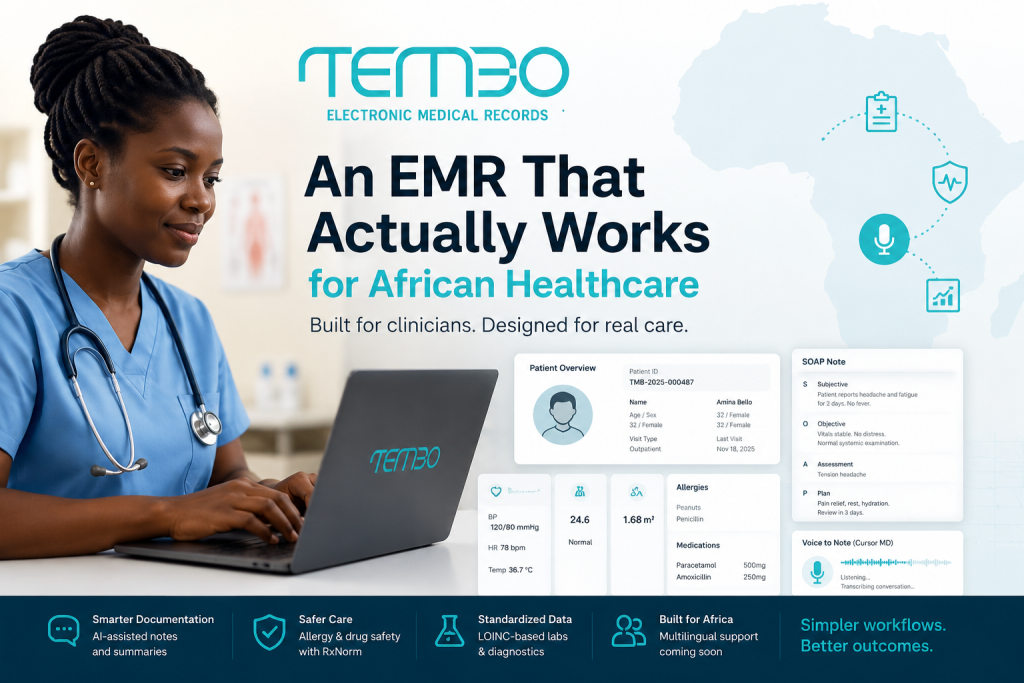
For years, healthcare systems have been told that digitization is the future.
Electronic Records are hoping for faster workflows, safer documentation, better continuity of care, and stronger clinical coordination, but as we’ve established in previous blog posts, instead of simplifying care, many EMRs introduced new frustrations like endless clicks, rigid workflows, overwhelming interfaces, duplicated documentation, and systems that seemed designed more for administration than for medicine itself.
So what happens when you intentionally design an EMR around the realities clinicians actually face?
Healthcare environments are fast-paced, unpredictable, and cognitively demanding. Clinicians juggle consultations, emergencies, investigations, prescriptions, documentation, and patient communication simultaneously.
A usable EMR cannot ignore this reality.
Tembo EMR was built around a simple philosophy: Digital systems should reduce friction, not create more of it.
Instead of forcing clinicians into rigid workflows, the system is designed to support how care naturally happens.
The focus is not on adding complexity, but on creating an experience that feels intuitive, structured, and clinically supportive.
This thinking influences everything from data entry to clinical documentation and research standardization.
A brilliant solution built under Clinical Records Hub (CRH), Tembo EMR is part of a broader effort to make African health data research-ready while directly improving point-of-care efficiency.
What dilemma is Tembo equipped to solve?
One of the most exhausting parts of modern healthcare is documentation fatigue.
Tembo approaches this differently through intelligent assistance during documentation.
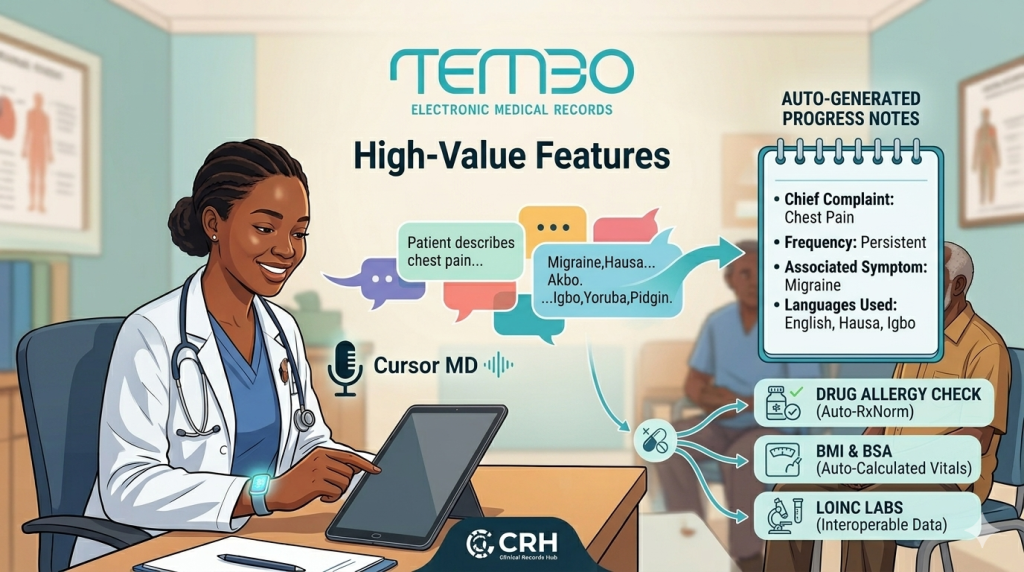
Rather than relying entirely on manual input, the system supports easier data entry through suggestions for symptoms and diagnoses, helping clinicians document faster while improving consistency across records.
Furthermore, in busy clinical settings, small tasks tend to accumulate quickly. Calculating BMI, estimating Body Surface Area (BSA), and interpreting vitals may seem minor individually, but repeated hundreds of times across patient encounters, they contribute significantly to the workload.
Tembo offers easy data entry with basic Clinical Decision Suport (CDS)
Tembo is capable of generating estimates such as BMI and BSA upon entry of patient parameters and can assist with triage interpretation using inputted vitals.
Another great challenge in African healthcare systems is that vast amounts of clinical information remain difficult to analyze at scale because documentation is inconsistent and fragmented.
Tembo addresses this through standardized investigation conventions using systems such as LOINC, helping ensure laboratory and diagnostic records remain structured, interoperable, and research-ready.
Another striking quality of Tembo is its drug safety. Drug safety remains one of the most critical responsibilities in healthcare, especially in high-pressure environments where fatigue and information gaps increase the risk of error.
Tembo incorporates smart drug allergy checking using standardized drug naming conventions such as RxNorm, helping create consistency in medication records and improving allergy detection reliability. This creates a more clinically meaningful allergy history rather than a simplistic checkbox system.
Perhaps one of Tembo’s most important ideas is that clinicians should not have to choose between documentation and patient engagement.
Tembo’s AI-assisted Voice tooling
Through Tembo Voice, an STT API, patient-doctor conversations can be transformed into structured progress notes and SOAP summaries, reducing the manual burden of note-taking.
The platform’s AI-powered voice tooling is designed to support clinical documentation workflows rather than interrupt them.
The long-term vision extends even further into multilingual healthcare support, with planned low-latency transcription across English, Hausa, Yoruba, Igbo, and Pidgin to improve inclusivity in clinical interactions.
In a continent as linguistically diverse as Africa, language should not become a barrier to safe healthcare delivery.
Tembo intentionally prioritizes a relatively simple and intuitive interface.
Its proof-of-concept design emphasizes modular content panes, accessible patient overviews, and streamlined action controls to make navigation easier during active clinical work. Faster navigation reduces delays. Simpler systems improve adoption.
We are ready to serve African Health Care.
Tembo EMR is not being built simply as another hospital software platform.
It is part of a larger effort to rethink how healthcare data, documentation, and research infrastructure can work together across African healthcare systems.
The future of digital health in Africa will not be shaped by systems with the most features.
It will be shaped by systems that genuinely understand the realities of care delivery and quietly support the people carrying it out every day.
Africa does not need just another EMR.
It needs a system that listens, adapts, and helps clinicians care better.
Tembo is that system.📌
