
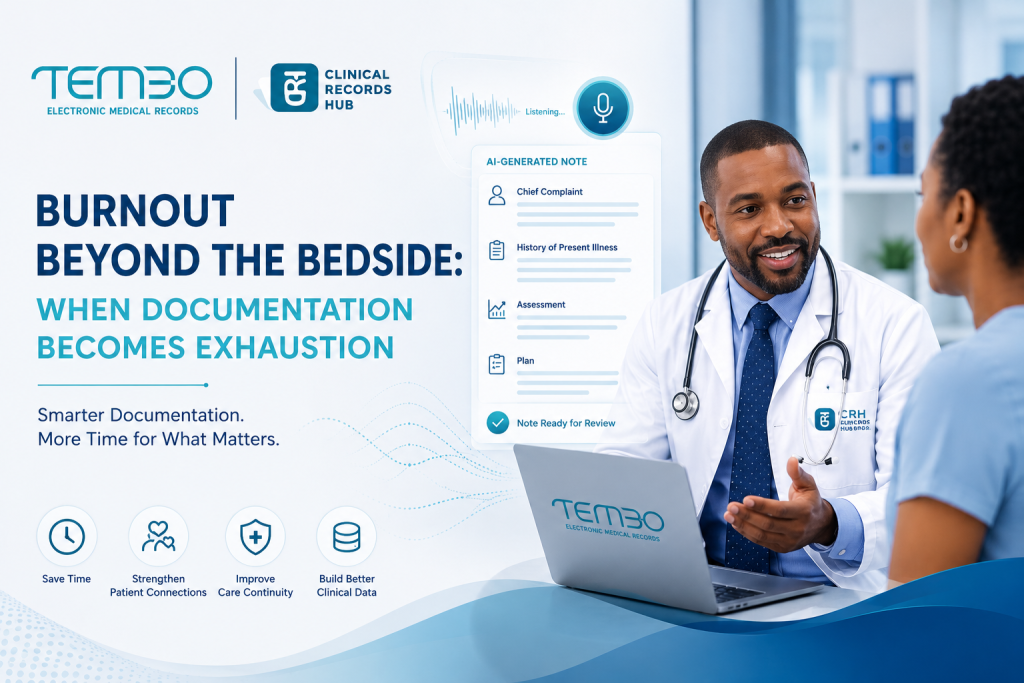
Every patient deserves the clinician’s full attention, but symptoms need to be recorded, investigations need to be requested, progress notes need to be written, treatment plans need to be captured, forms need to be completed, and compliance requirements need to be met. Therefore, at the end of the consultation, the clinician may have spent as much time documenting the visit as they spent conducting it.
Across healthcare systems worldwide, clinicians are spending increasing portions of their day documenting care rather than delivering it effectively, turning professionals trained to care for patients into Data Entry Personnel. This shows how much of an inconvenience conventional documentation methods and failing EMRs are to proper healthcare.
Documentation is essential; without it, the continuity of care suffers. The task itself is not the problem; the issue is how it is done. A doctor may finish seeing patients, but still spend hours completing forms and updating records afterwards. A nurse continues to complete charts long after medication rounds. In a nutshell, health care workers often carry administrative responsibilities that stretch beyond working hours.
Sadly, in many settings, this extra workload has become so common that it is simply accepted as part of the profession but normal does not mean harmless. The cumulative effect is significant, mental fatigue increases, attention meant for patients is fragmented, burnout accelerates and ultimately patient care suffers.
What gets lost when Clinicians have to focus so heavily on typing rather than talking?
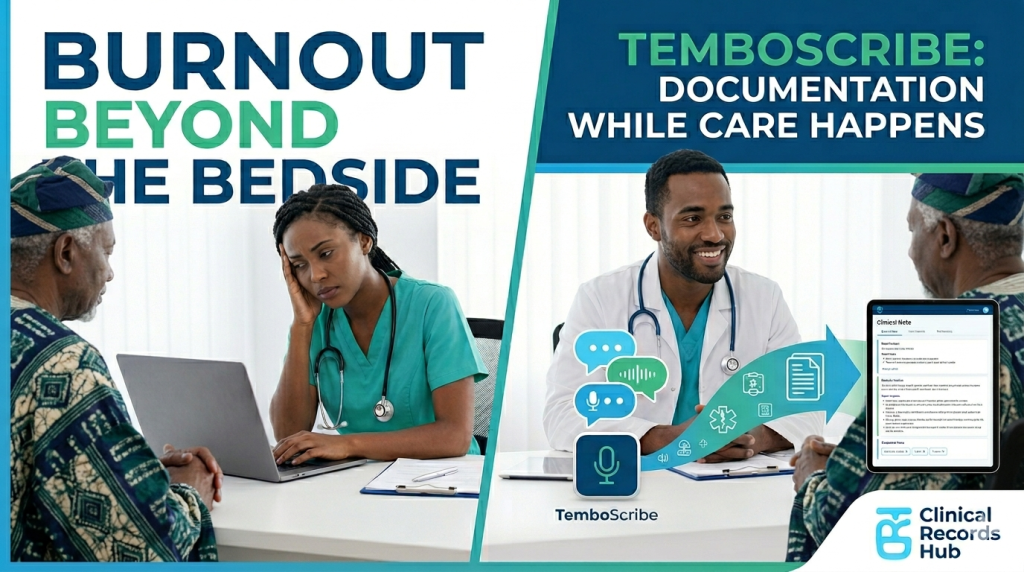
The obvious answer is the time spent; the less obvious answer is connection. Healthcare is fundamentally human, a patient is often at their most vulnerable when sitting across from a healthcare professional looking for reassurance, understanding, explanations, seeking trust yet documentation frequently competes for the Clinician’s attention.
Th consultation becomes divide between the patient and the document for the patient, eye contact is interrupted, follow up questions are often forgotten and subtle details may be missed.
The challenge is not choosing between patient interaction and documentation. The challenge is that both are absolutely necessary.
What if Documentation Happened While Care Happened?
Point blank, Healthcare cannot function without records. Clinical notes protect patients, they support care continuity, facilitate referrals, provide legal protection and importantly, enable research. The goal is not to eliminate documentation but unnecessary documentation effort.
For years, digital systems have promised this outcome yet many simply replaced papers with keyboards. The medium changed but the burden still remained. To truly improve health care workflows, documentation must become smarter. The objective is simple: Allow Clinicians to Practice Medicine while Technology Assists with Documentation.
At Clinical Records Hub (CRH), this philosophy is reflected in TemboScribe.
TemboScribe is designed to convert patient clinician conversations into structured progress notes, reducing the administrative effort required to document encounters while preserving the quality of records. Instead of beginning with a blank note after every consultation, the clinician can review AI-generated documentation based on the conversation that already occurred.
A typical workflow might look like this:
A patient enters a consultation room – The Clinician conducts the consultation normally while Tembo listens – Symptoms, concerns and relevant history are discussed naturally – Tembo captures the conversation and generates a structured clinical note – The clinician reviews the output, makes any necessary adjustments and approves it.
Documentation that might have taken several minutes or longer is completed with significantly less manual effort, the clinician remains engaged with the patient, the patient receives more focused attention, the healthcare record remains complete. The beauty is not replacing clinical judgement, but supporting it.
Beyond Speed; Building Better Records
The value of smarter documentation extends beyond saving time, structured notes improve consistency, which in turn improves continuity of care and better continuity improves outcomes.
Structured documentation creates stronger clinical databases that can support research, quality improvement and evidence-based decision-making. Documentation should not merely capture care; it should help improve future care.

This aligns closely CRH’s broader vision of creating structured clinical data that supports both frontline healthcare delivery and long-term medical research. With Tembo, every consultation represents not only a patient encounter but also an opportunity to generate knowledge that can strengthen healthcare systems over time.
The future of health care documentation should not be measured by how much information we capture. It should be measured by how much meaningful time we can return to clinicians and patients. The most valuable outcome of this all is not faster documentation but better care.
At the center of all, TemboEMR remains ready to serve.
