
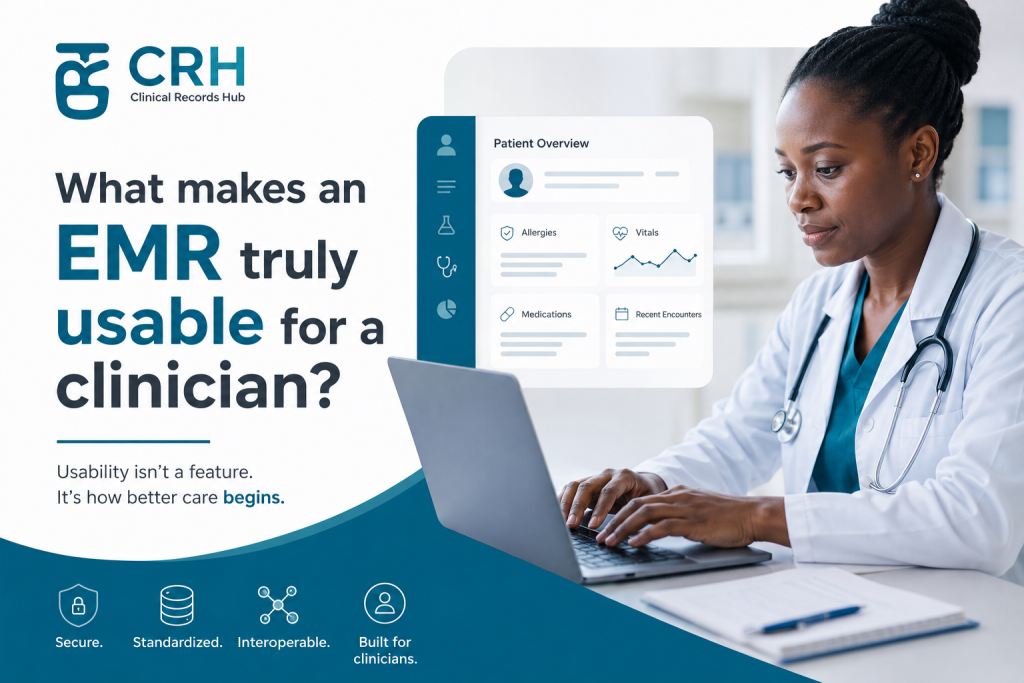
An Electronic Medical Record (EMR) simply put is a digital version of a patient’s record that is useful for healthcare purposes.
It often consists of a patient’s diagnosis, medical history, allergies, and treatment plans.
With EMRs comes the ability to solve a very simple but critical problem: Healthcare information should not be scattered, delayed, or lost.
The technology guarantees faster access to years of medical history, lesser errors and overall better coordination when it comes to tracking, scheduling appointments and monitoring patient records.
But what happens when EMRs fail to serve as solutions?
In low resource settings and many real clinical settings, especially in resource-stretched hospitals, EMRs feel like another tedious system for the clinicians to survive and not rely on.
Instead of reducing workload, they add to it.
This poses a concern which is not whether hospitals should adopt EMRs, but whether the software being adopted are actually usable.
What Problem Should an EMR Be Solving?
At its core, an electronic medical record should solve the problem of clinical fragmentation.
Every patient encounter generates critical information: symptoms, diagnoses, investigations, prescriptions, treatment plans, and follow-up notes. If these records are incomplete, scattered, or inaccessible as is often the case with manual records, clinicians are forced to work with missing context, leading to repeated tests, delayed decisions, avoidable errors, and poor continuity of care.
A usable EMR should reduce these risks by making clinical information easy to capture, easy to retrieve, and easy to interpret, even during high-pressure patient encounters.

Why Existing EMRs Aren’t Getting the Job Done
The reality is that many EMRs are designed around documentation, compliance, or administrative reporting not around real clinical workflow.
In practice, clinicians experience systems that require too many clicks, too many fields, and too much time to fill in. Instead of speeding up care, these systems slow it down in the name of digitization.
Many EHRs also fail because they assume ideal working environments: stable internet, uninterrupted power supply, enough computers, and staff who have the time to learn complex interfaces but our healthcare is rarely ideal. Clinicians work in urgent, unpredictable settings, and software that does not respect this reality becomes frustrating quickly.
Even worse, when EMRs are poorly implemented, clinicians begin to distrust them. They revert to paper notes, informal documentation, or partial record-keeping, defeating the entire purpose of digitization.
What Makes an EMR Truly Usable?
A usable EMR is not necessarily the one with the most features. It is the one that supports clinicians with speed, intelligence, and minimal friction. It should feel like an assistant not a burden.
Below are the key features that separate functional software from frustrating ones:
- Ease of Data Entry
Documentation is unavoidable, but it should not be exhausting because Clinicians really do not have the time.
A usable EMR should support rapid entry through smart clinical suggestions. For example, when a clinician begins typing symptoms, the system should suggest common clinical terms and allow structured selection.
The same should apply to diagnoses, ensuring faster documentation while improving consistency across records.
When documentation is structured and standardized, the system becomes useful for analytics, research, and continuity of care without frustrating the Clinician. - Smart Patient Detail Estimates at Entry
Clinicians should not have to calculate everything manually.
A well-designed EMR should automatically estimate key clinical values once patient parameters are entered and give visual indicators for aberrations and outliers.
For example, upon entering height and weight, the system should instantly calculate BMI and Body Surface Area (BSA), weekly alcohol consumption, smoking pack years, which are clinically important for medication dosing, chemotherapy planning, and patient assessment. - Allergy Tracking, Storage, and Clinical Intelligence
Most EMRs stop at a simple checkbox: “drug allergy: yes/no” but a clinician-friendly system should do more. It should store allergies properly and provide context such as the suspected allergen, the reaction type, severity, and how the allergy was derived whether self-reported, observed, or confirmed.
Even better, the system should offer intelligent suggestions about potential cross-reactivity or allergenicity.
This is not a luxury feature. It is patient safety. - Standardized Investigation Conventions (LOINC for Research and Continuity)
A usable EMR should standardize investigations using globally accepted systems such as LOINC (Logical Observation Identifiers Names and Codes). This ensures that investigations are named consistently, results are comparable, and patient data can be aggregated across departments or even across hospitals.
Without it, clinical records remain fragmented even inside a digital system. - A Simple Interface That Matches Clinical Thinking
Even the smartest EMR fails if the interface is overwhelming.
A usable software should be clean, intuitive, and aligned with how clinicians think. Key patient information should be visible at a glance, navigation should be predictable, and essential tasks should be accessible in minimal steps.
Clinicians do not need decorative dashboards. They need clarity.
The Real Truth About EMR Usability
EMR usability is not a “design preference.”
It is a patient safety issue.
A slow system delays care.
A confusing interface increases errors.
A poor documentation workflow worsens burnout and a fragmented EMR defeats the purpose of digital health entirely.
If healthcare is going to digitize successfully, EMRs must stop being designed around data collection alone. They must be designed around the realities of clinical care, fast-paced, high-pressure, and deeply human.
The future of digital healthcare is not about installing systems. No, it is about building systems that are intelligent, standardized, safe, and genuinely usable. EMRs should reduce workload, strengthen decision-making, improve continuity, and unlock clinical data for research and progress.
As hospitals across Africa continue to adopt digital tools, we must ask better questions, not just “Do we have an EMR?” but “Does our EMR actually help clinicians deliver better care?”
The answer to that question will determine whether digital health becomes a revolution or just another layer of complexity.
