Unlocking Better Patient Care in Nigeria: Why You Need a EMR with Interoperability
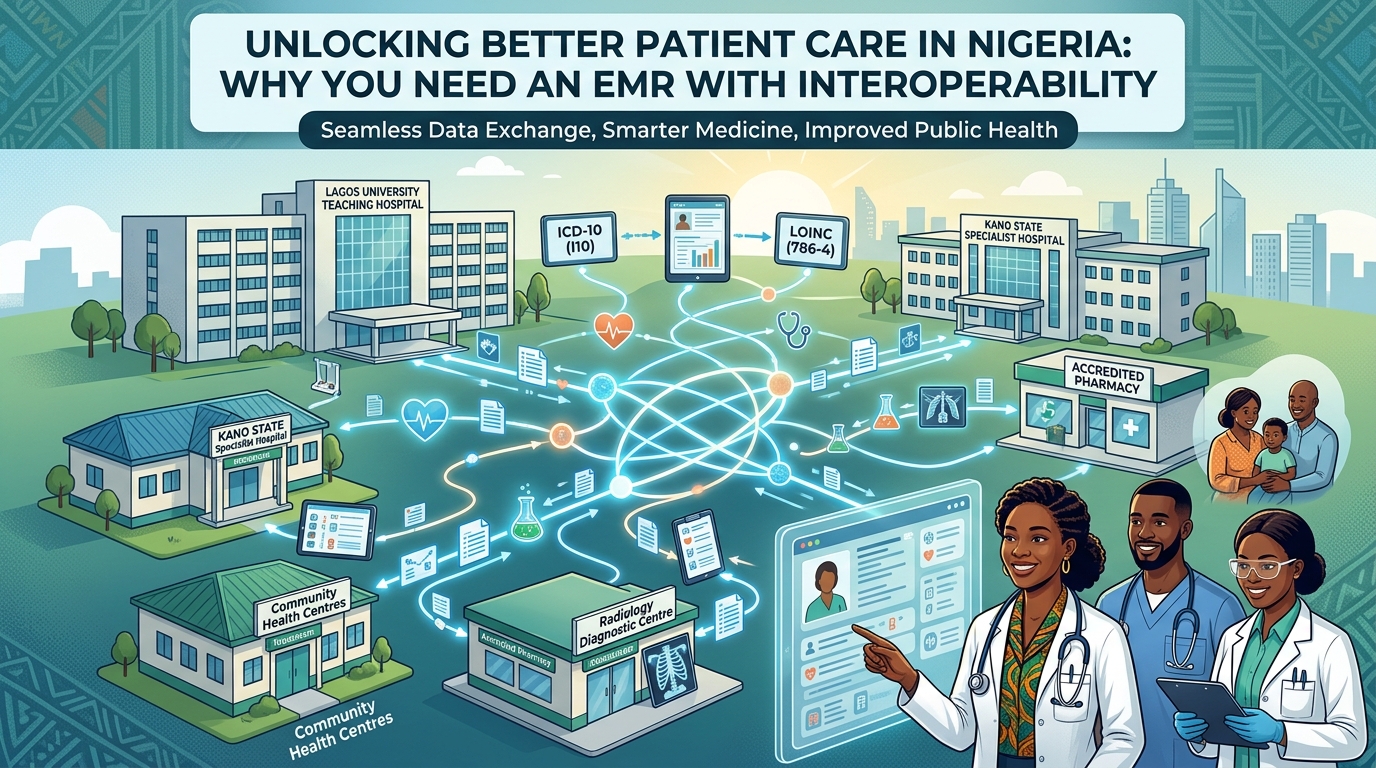
The Institute of Electrical and Electronics Engineers defines interoperability as the ability of a software (or hardware) to work with other products or systems and allow for information exchange. In healthcare, this is more than just a technical feature. Instead, it is a vital tool for effective treatment, disease tracking, and public health research.
Healthcare is inherently collaborative. A patient’s care rarely involves a single clinician. Instead, hospitals, labs, pharmacies, and insurers all use the same medical data. When these systems cannot talk to each other, care becomes fragmented. Consequently, this leads to administrative waste and dangerous medical errors.
WHY WE NEED INTEROPERABLE DESIGNS IN EMRS
A clinical progress note is essentially a story. It documents the journey of a patient from the onset of symptoms to diagnosis, treatment, recovery, or long-term disease management. These notes capture the reasoning behind a clinician’s decisions and form a core component of the patient’s medical record.
In theory, such documentation should be enough to guide patient care. In practice, however, healthcare delivery extends far beyond the physician’s note.
A patient’s treatment pathway may involve:
Drug dispensing at pharmacies
Diagnostic tests in laboratories
Imaging procedures in radiology departments
Billing and insurance claim processing
Regulatory audits by medical boards
Continuity of care across multiple healthcare institutions
Each of these steps requires data that machines and humans can both read. When systems use incompatible formats, every process slows down. As a result, care becomes more expensive and prone to mistakes.
THE HIDDEN COST OF NON-STANDARDIZED MEDICAL DATA
Here, we study some of the ripple effects caused by the ambiguity of a “HTN” diagnosis:
“A patient’s diagnosis was documented as “Essential HTN”; this is clinically accurate and thoroughly precise. A management regime for the patient is already in view.”
Essential hypertension is also known as primary hypertension. It can be shortened into various formats readable to clinicians and experts. However, it is messy with data aggregation and epidemiology, and becomes expensive when mapping “Essential HTN”, “Primary HTN”, “Primary Hypertension” and “Essential Hypertension” to a single diagnosis. It doesn’t look like much, but once we add more diagnoses it becomes a headache to track. The resulting bottleneck would reflect in:
Epdemiology and disease tracking
Insurance claim management
Data fragmentation and eventually, blind policy making.
THE ROLE OF GLOBAL MEDICAL STANDARDS FOR INTEROPERABILITY
Organizational standards and best practices were invented to combat these bottlenecks, and ensure that medical data can be interpreted consistently across different systems that normally wouldn’t talk to each other. Below are the most commonly used medical vocabularies.
The International Classification of Diseases (ICD) is one the most widely used diagnostic classification systems, developed by the World health Organization (WHO), providing a structured system of codes for diseases, symptoms, and medical conditions. Essential Hypertension is coded “I10” in the 10 revision of ICD (ICD-10), meaning everywhere essential hypertension is mentioned, the code I10 is used. This makes searches across all compliant systems simple, fast, and research ready.
LOINC Logical Observation Identifiers Names and Codes (LOINC) is the golden the standard vocabulary for laboratory tests and clinical measurements. It exists to bridge the gap between each vendor machine analysers, ensuring that different labs with various vendors can understand and refer to the same investigation measurement. For cross-sectional studies, where specific investigation parameters are needed in the study, for example identifying the Mean Corpuscular Hemoglobin Concentration (MCHC) in Sickle-cell patients across 10 hospitals in Nigeria, Ghana and Kenya among other parameters, LOINC gives the ability to find that parameter, separated by the method used. MCHC is coded “786-4” by by Automated count and “47279-5” from Cord blood. These nuances might be missing if this ontology isn’t used.
Rx for Drugs RxNorm is one of the most advanced medical vocabularies out there for medical drug, and might be one of the most essential for patient-care. It classifies drugs with codes, showing the drug relationships, attributes and the various forms of the medication and how they’re found. This is also vital in patient care where a patient might have documented adverse drug reactions (ADRs) to a specific component in the medication. Those relationships are quickly identified to prevent accidents. It provides a normalized naming system that allows different software programs to share drug information efficiently
These standards work together, ensuring that medical systems can communicate effectively by sharing a common clinical language.
WHY INTEROPERABILITY MATTERS FOR RESEARCH AND PUBLIC HEALTH
Beyond immediate patient care, interoperability has profound implications for medical research and public health.
When health records are structured using common standards such as ICD, LOINC, and RxNorm, researchers can aggregate and analyze data across multiple institutions. This enables large-scale studies on disease prevalence, treatment outcomes, and healthcare trends.
Tembo EMR was built with interoperability in mind, to ensure that your digitalised medical data is also research ready because adopting and implementing standards is not just about improving software; it is about improving the quality of care itself, and finally utilizing the medical data available in Nigeria
You should also read:
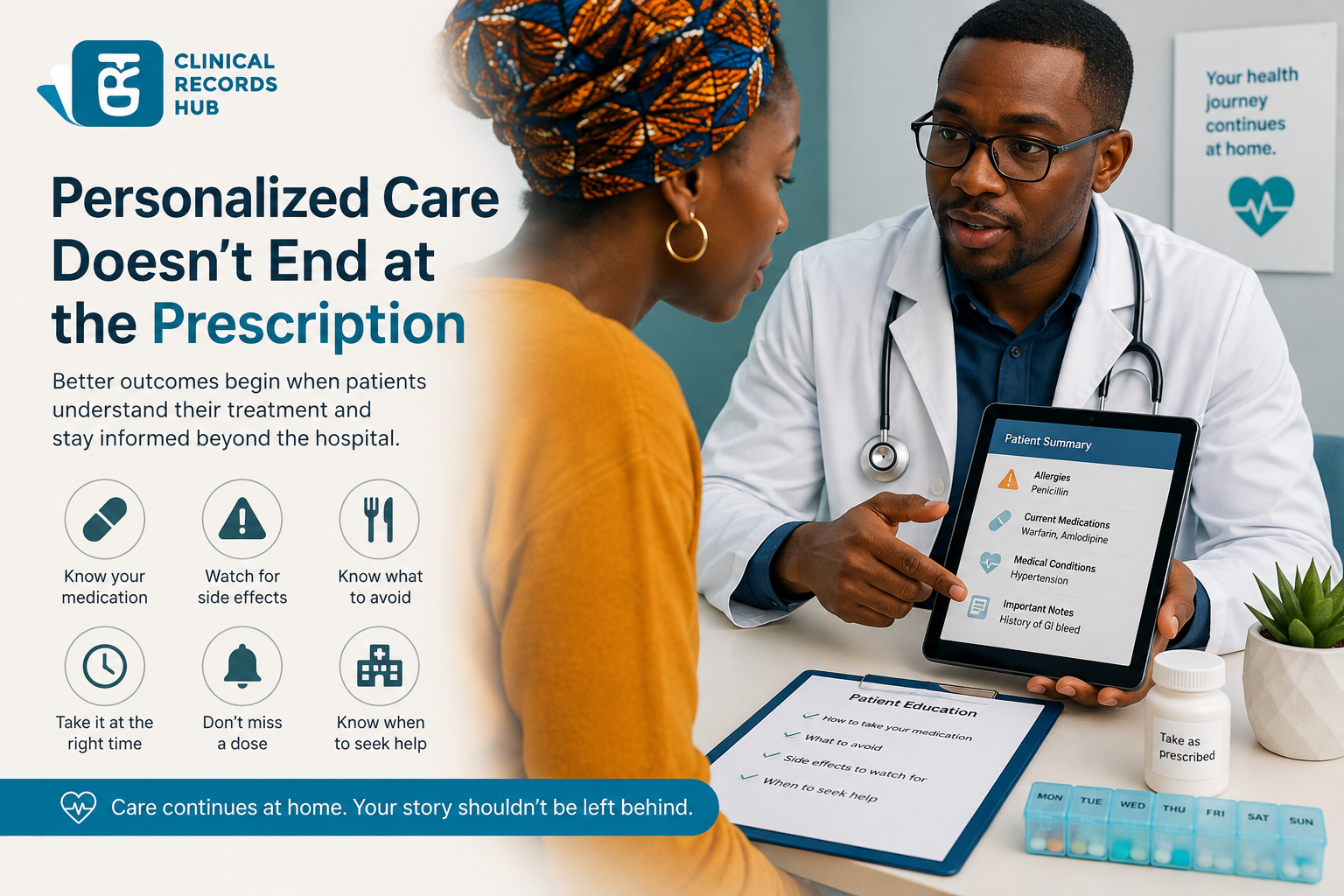

Beyond the Prescription: Why Post-Hospital Care and EMR Integration Matter
One thing is for sure: we’re all too familiar with what happens inside a hospital and everything it entails. But we’re not always as in touch with what happens after a patient walks out of it. And frankly, that’s where many treatments can begin to…
Continue reading...
The Patient’s Story is Only As Good As Its Documentation
The Patient’s Story is Only As Good As Its Documentation Every patient encounter has a narrative not just about what happened but why it happened, what changed, what improved, what worsened and what should happen next. That narrative is carried through Clinical documentation. When documentation…
Continue reading...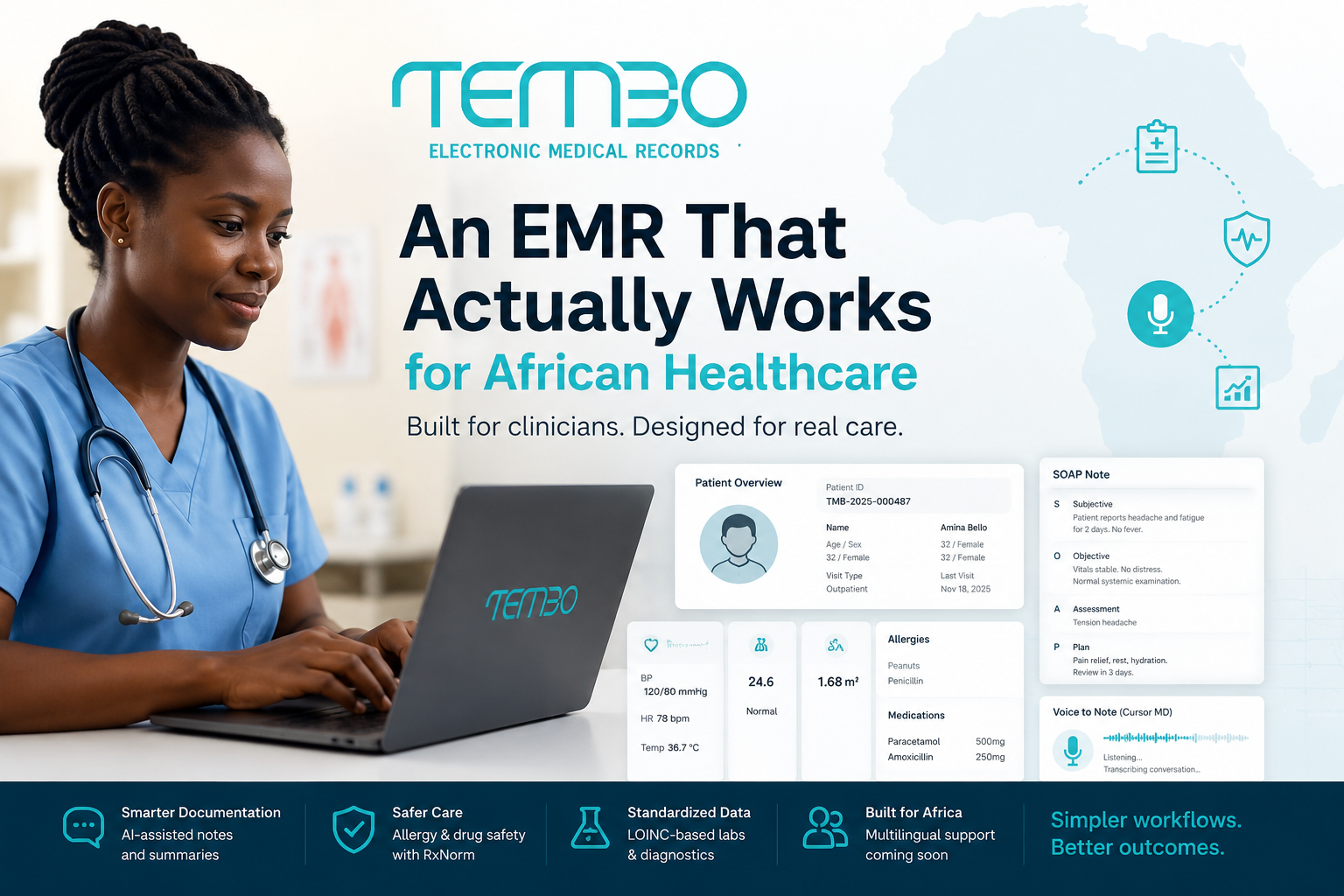
Tembo: An EMR That Actually Works for African Healthcare
For years, healthcare systems have been told that digitization is the future. Electronic Records hoping for faster workflows, safer documentation, better continuity of care, and stronger clinical coordination but as we've established in previous blog posts, instead of simplifying care, many EMRs introduced new frustrations…
Continue reading...
Comments