Clinical Data Standardization: Frameworks, Use Cases, and Limitations
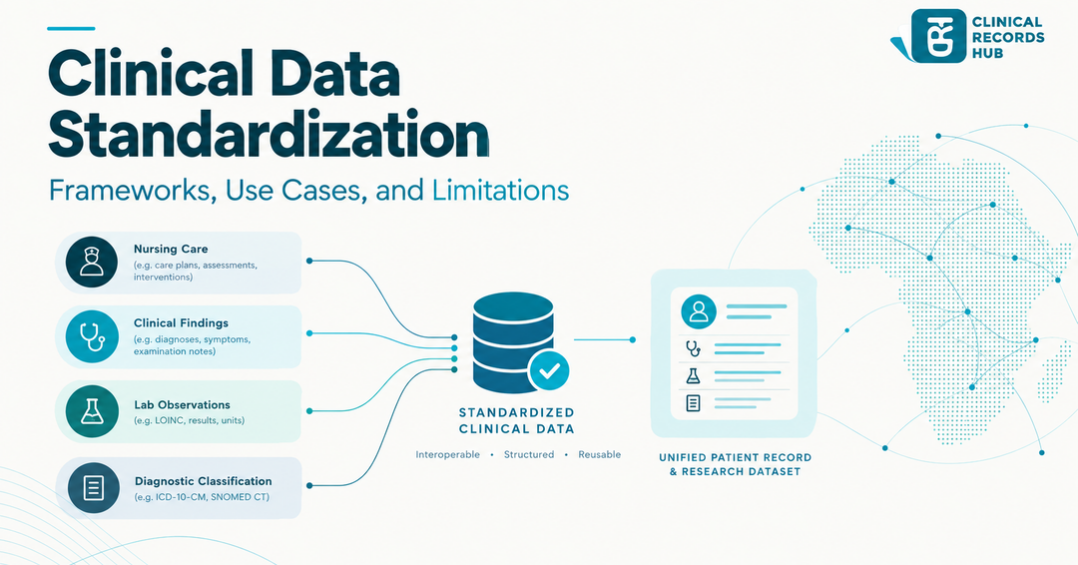
A clinical document captures the patient's journey across various medical stations. To ensure the data remains usable beyond the individual encounter, the information it contains must be represented in ways that other healthcare professionals, information systems, and research workflows can interpret consistently.
This is crucial because the quality of a patient's record influences continuity of care, clinical decision-making, patient safety, and public health decision-making, especially with epidemiology and disease tracking. However, even a well-documented clinical note presents another problem; how do we make the information consistently interpretable across clinicians, departments, healthcare facilities, and research datasets?
This problem is addressed by "clinical data standardization".
Clinical terminologies and classification systems provide standardized ways to represent specific aspects of patient care. When integrated appropriately into an Electronic Health Record (EHR), they help transform clinical documentation into data that can be retrieved, validated, compared, and analyzed.
However, these systems are not interchangeable. Each serves a different purpose in the clinical data lifecycle.
Nuring Care Documentations: Clinical Care Classification (CCC)
Nursing documentation captures observations, identified care needs, interventions, and patient responses throughout a patient's stay. For this information to support meaningful analysis across encounters, its clinical meaning must be represented consistently
The Clinical Care Classification (CCC) system provides a standardized framework for representing nursing diagnoses, interventions, and outcomes.
Case Study: CCC Coding for a Pulmonary Diagnosis and Intervention
- A patient in the ward presents with observed difficulty breathing and an SpO₂ of 80%. The CCC cluster for breathing and the pulmonary system is coded as L.
- As with ICD-10, CCC diagnoses are divided into a major diagnosis and sub-diagnoses. 26.0 refers to a Respiratory Alteration, while 26.2 specifies the patient’s symptom as Breathing Pattern Impairment, which may involve inadequate inhalation or exhalation. The third CCC component is the expected outcome from the diagnosis. In this case, 3 indicates the expected outcome related to deterioration. This gives the Diagnosis Code:
L.26.2.3. - The intervention is structured as follows. L remains the pulmonary system cluster. 36.0 refers to Pulmonary Care, described as actions performed to support pulmonary hygiene, and 36.1 is the sub-intervention for Breathing Exercises. The code 2 refers to the action type, in this context, to perform. Finally, 1 refers to the outcome: improvement. The Intervention Code:
L36.1.2.1
For this nursing documentation, the final code set is: L26.2.3 / L36.1.2.1
Across multiple facilities, appropriately standardized data could support comparisons of nursing care processes and outcomes, provided that differences in patient populations, care practices, and documentation quality are also considered.
Clinical Findings and Diagnoses: SNOMED CT
SNOMED CT is a comprehensive clinical terminology designed to represent clinical meanings using concepts, descriptions, and defined relationships.
When an EHR uses SNOMED CT appropriately, relevant clinical findings and diagnoses can be associated with standardized concepts. This enables systems to retrieve related information even when the original descriptions differ.
For example, consider a patient whose record documents shortness of breath. Another clinician may use the term dyspnoea. Depending on the clinical context, these expressions may represent the same concept and can be mapped accordingly.
This has important implications for clinical decision support (CDS). A decision-support rule may need to identify specific findings, conditions, or combinations of clinical information before presenting an alert or recommendation. Standardized concepts can help the system identify relevant data consistently.
Diagnostic Classification: ICD-10 and ICD-11
An established diagnosis may be mapped to an appropriate ICD category for a reporting or classification workflow. This supports the aggregation of records into defined diagnostic groups.
For example, a hospital may need to produce a report on patients diagnosed with diabetes during a particular period. Appropriate ICD coding can support consistent classification and counting, provided the coding rules, inclusion criteria, and reporting requirements are applied correctly.
How Standardization Works in a Real EHR
Consider a patient admitted with a diabetic foot ulcer who receives nursing care, undergoes laboratory investigations, and has their diagnosis reviewed during the admission.
The EHR may need to represent several distinct aspects of the encounter:
- Nursing care: CCC can support the standardized representation of relevant nursing diagnoses, interventions, and outcomes.
- Clinical findings and conditions: SNOMED CT can represent appropriate findings and diagnoses in a consistent clinical terminology.
- Laboratory investigations: LOINC can identify the relevant observations and tests.
- Diagnostic classification: ICD can classify the documented diagnosis for an applicable reporting workflow.
These representations can coexist within the same patient record because they address different information requirements.
How data standardization improves clinical research
A research team studying diabetic foot complications, for example, may need to combine diagnostic information, laboratory measurements, nursing interventions, and subsequent outcomes across multiple facilities.
Without consistent data representations, researchers may need to reconcile local codes, investigate ambiguous test names, and manually determine whether different entries refer to comparable clinical concepts.
Appropriate standardization can reduce this burden and improve the reproducibility of data retrieval and analysis.
Limitations to Clinical Documentations
Data standardizations and coding might involve a loss of clinical detail. Different clinical concepts may map to the same category, or be grouped broadly, depending on the classification, ontology philosophy, and the available level of specificity. The resulting code should therefore not be treated as a complete substitute for the underlying clinical record, but as a snapshot summary of the patient's medical record for data aggregation in medical research.
You should also read:
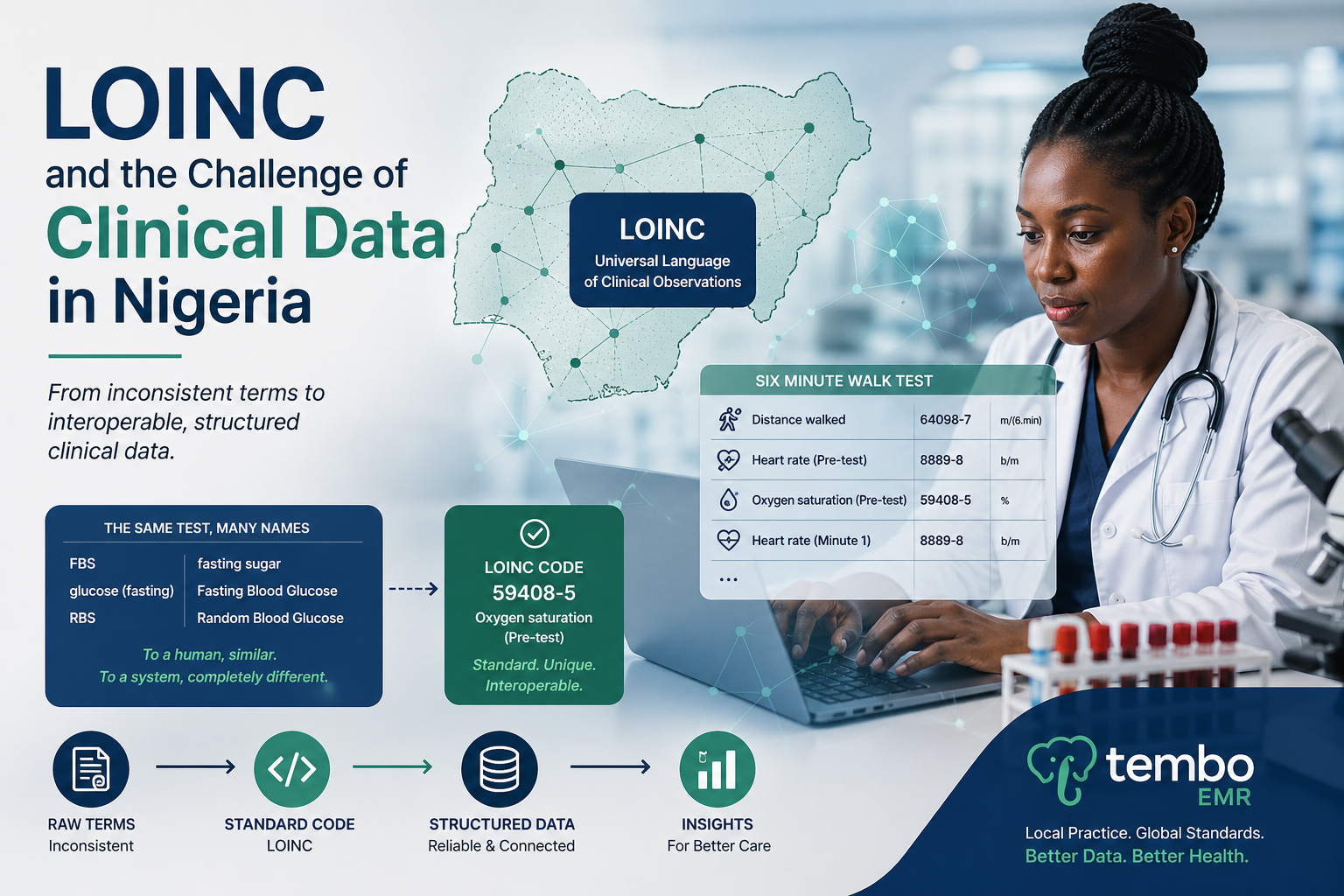
LOINC and the Challenge of Clinical Data in Nigeria
In the Nigerian clinical space, something as simple as "blood sugar" is not actually simple. Depending on the hospital, lab, analyser, and available equipment, "blood sugar" could refer to: Each of these may be recorded differently: To a human, these might seem interchangeable. To a…
Continue reading...

Hospitals Are Sitting on Gold: Why Clinical Data in Africa Remains Untapped
Why does Africa generate massive clinical data but benefit so little from it? A big question, one you may have already given an answer in your mind. If you thought of paper records, fragmented data collection, or manual clinical workflows, you're not wrong, we’re of…
Continue reading...
Comments