
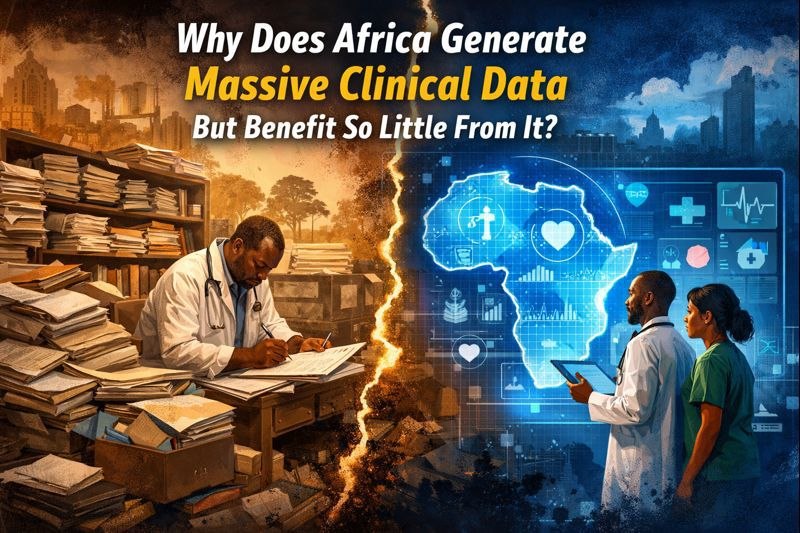
Why does Africa generate massive clinical data but benefit so little from it?
A big question, one you may have already given an answer in your mind. If you thought of paper records, fragmented data collection, or manual clinical workflows, you’re not wrong, we’re of the same mind. These factors continue to shape how healthcare data is generated, stored, and used across many African hospitals.
A 2019 World Bank study of seven African nations found that approximately 80% of potential data sources were still in paper formats, with only 20% digitized for analysis at the time. It’s 2026, and while digital health adoption in Africa has certainly improved, progress remains uneven, particularly in resource-limited settings and vulnerable communities where health systems are least prepared for emergencies..
Across hospitals in Africa, every patient encounter creates something valuable. A diagnosis, a lab result, a treatment outcome and a follow-up note. Together, these form clinical data records which is the raw material for better patient care, stronger medical research, and strengthening health systems. Yet despite the volume of care delivered daily across the continent, much of this data remains locked away, underused, and unseen.
The Result?
Africa generates data but struggles to transform it into actionable, localized health intelligence, leaving its population underserved by global health innovations.

The Paper Problem Still Persists
Despite increased conversations around electronic medical records (EMRs) and health information systems, many African hospitals and health care centres still rely heavily on paper-based clinical documentation. Files are stored in shelves, cabinets, and record rooms often vulnerable to damage, loss, or misfiling.
Paper records clearly make it difficult to:
- Track patient history across visits.
- Aggregate data for population health analysis.
- Identify disease trends or treatment outcomes.
- Support large-scale clinical research in Africa.
When data exists but cannot be accessed efficiently, it cannot inform decision-making.
Furthermore, manual data entry, filing, and retrieval place a heavy burden on healthcare workers. Clinicians already operating under extreme pressure must spend additional time documenting, searching for records, and repeating tests due to missing information.
This reliance on manual health records reduces efficiency and increases the risk of errors while also contributing to clinician burnout.
Fragmented Data Systems, Fragmented Insights
Even in facilities that have adopted some form of digitization, such as Electronic Medical Records, health data fragmentation remains a major challenge. Data may be split across departments, laboratories, pharmacies, or standalone software systems that do not communicate with one another. The result is isolated data silos, where valuable clinical information exists but cannot be connected, analyzed, or shared.
This fragmentation weakens:
- Continuity of patient care.
- Collaboration between different healthcare professionals or departments.
- Multi-center research collaboration.
- Evidence-based policy development.
Without interoperable health data systems, insights remain incomplete.
The Cost of Untapped Clinical Data
The consequence of these challenges is truly profound. Africa produces vast amounts of clinical data but struggles to convert it into actionable health intelligence. It limits:
- Proper patient care.
- Local disease surveillance.
- Context-specific treatment guidelines.
- Data-driven health policy.
- African-led medical research.
As a result, global health innovations often rely on data from elsewhere, while African populations remain underserved not due to a lack of data, but due to an inability to unlock its value.

Clinical data is one of healthcare’s most valuable assets yet across many African hospitals, it remains underutilized, fragmented, and inaccessible. Until health care systems are designed to capture, organize, and learn from this data effectively, Africa will continue to sit on a goldmine it cannot fully access.
As conversations around the strengthening of health systems continue, it is worth asking:
What does it truly take to unlock Africa’s clinical research potential?
Liked this article? Follow us on Instagram for more updates from the Clinical Records Hub.
