
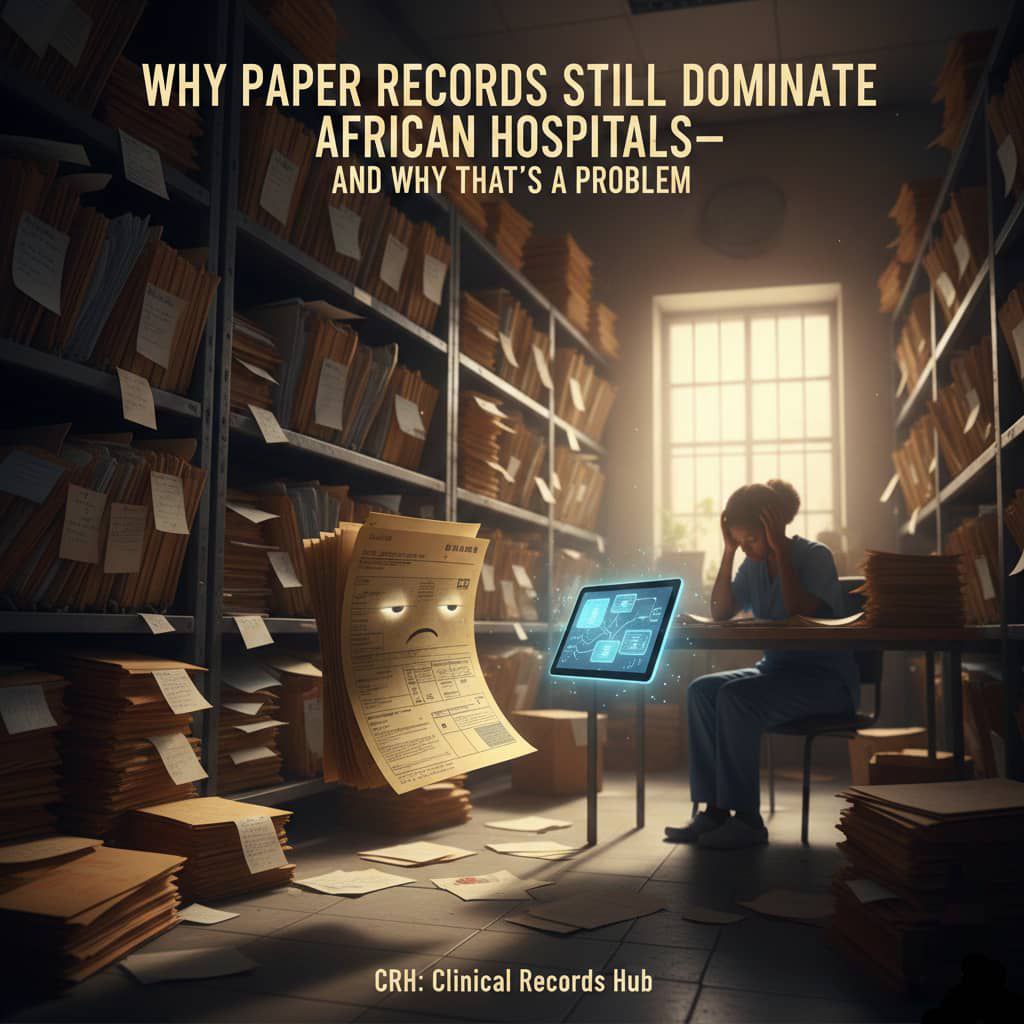
Hi I’m Paper, Walk with Me.
I’ve been around for quite a long time longer than most people remember. I’ve held your medical history, records, your lab results, your prescriptions, your diagnoses, your hopes and your dreams.
I’ve sat quietly in folders, cabinets, and record rooms across hospitals forming the backbone of clinical records for decades..
If you’ve ever been to a clinic, you’ve probably met me, held me, used me.
Now, walk with me.

I’ve Been Trusted for Decades
I became popular because I was simple and didn’t need electricity or codes.
I never crash and I never ask for passwords or updates. All I needed was a pen and a place to rest.
In hospitals and clinics, where resources were limited and healthcare systems were fragile, I felt safe. Familiar. Reliable. And for a long time, I worked.
But healthcare needs have changed.
And I…. haven’t.
I Get Lost Easily
Let me be honest with you. I’m not great at staying around.
Sometimes I slip behind a desk.
Or I end up in the wrong folder.
Sometimes I disappear entirely during dire periods.
When medical records go missing, your clinician is forced to guess. They ask you the same questions again, repeat tests and work without your full story. I sincerely don’t mean to cause harm but when I go missing, patient care slows down.
I Don’t Move Fast Enough
Hospitals are really busy places and I can barely keep up.
Patients move from waiting rooms to wards, from labs to clinics, from one department to another but I move slowly. I need hands to carry my volumes. Huge shelves to store me. Time to be searched for.
While someone is looking for me, patients wait and waiting is something that endangers critical cases healthcare already has too much of.
I Don’t Like Sharing
This part is actually uncomfortable to admit. I’m not good at collaboration.
If I’m in one department, I can’t easily be in another. If a patient is referred to a different hospital, I may not follow them at all, I’m stagnant and often unwilling to go with the flow of clinical documentation.
That means information becomes fragmented making coordinated care difficult and patients feel like they are starting over each time they see a new clinician.
I Hold Data, But I Can’t Speak
Written inside me are hidden patterns, trends, stories of disease which are all part of valuable healthcare data.
Clues that could significantly improve healthcare and guide medical research but I can’t organize myself. I can’t be counted easily. I can’t be analyzed at scale.
So those insights stay untapped not because they aren’t valuable, but because the work is daunting and I was never designed for learning.
I Ask a Lot from Clinicians
I need time. Time to write. Time to file. Time to search. Time to review.
Clinicians give me hours of their day, several hours that could have been spent listening to patients, explaining treatments, or simply resting from burnout. I never meant to contribute to burnout, but in busy healthcare systems, I know I quietly do.
I’m not The Villain…Just Outdated
Let me be clear. I am not bad nor useless. Neither, am I the villain of this story. I definitely served my purpose when healthcare was smaller, slower, and simpler.
I didn’t fail healthcare. Healthcare outgrew me. Patient volumes have grown. Care has become much more complex. Research now depends on data.
And I… am tired.

It Might Be Time to Let Me Rest
If healthcare is to move forward, I really mean if patient care is to significantly improve, if research is to advance, if clinicians are to breathe easier, then it’s worth asking hard questions about systems that no longer scale.
I’ve done my part.
Now, as much as it hurts me to say, it may be time for something more suited to the future.
Healthcare cannot improve if the systems holding its data cannot keep up.
If you work in healthcare, research, or hospital administration, it may be time to rethink how clinical records are created, stored, and trusted because better patient care begins with better records.
This article explores the limitations of paper-based clinical records and why rethinking documentation systems is essential for modern healthcare.
Follow Clinical Records Hub on Instagram to get more updates.
